An automated pipeline for synthesizing safety-critical data for safe and scalable deployment of end-to-end autonomous driving at anywhere in the world.
Jiawei Wang
Research Assistant Professor
University of Michigan Transportation Research Institute (UMTRI)
I am a Research Assistant Professor at the University of Michigan Transportation Research Institute (UMTRI).
Before joining UMTRI, I was a Lecturer in the Department of Civil and Environmental Engineering at the University of Michigan, Ann Arbor. I was also a Postdoctoral Research Fellow in the Mobility Transformation Lab, working with Prof. Henry X. Liu.
I received my Ph.D. and B.E. from Tsinghua University in 2023 and 2018, respectively, with my doctoral research advised by Prof. Keqiang Li. From Dec 2022 to Dec 2023, I was a visiting PhD student in the Automatic Control Laboratory at EPFL (École Polytechnique Fédérale de Lausanne), advised by Prof. Colin Jones. During my doctoral research, I also received guidance from Prof. Yang Zheng at UC San Diego.
Research
My research lies at the intersection of machine learning, control, optimization, and simulation, addressing how autonomous systems can operate safely and efficiently alongside people in complex urban environments. With a primary focus on autonomous driving, I develop generative AI methods for high-fidelity simulation and rigorous safety evaluation, as well as reliable and scalable data-driven control strategies. Through these efforts, I aim to advance safe, efficient, and sustainable urban mobility.
News
- 10/2026Excited to begin my new role as a Research Assistant Professor at UMTRI, University of Michigan!
- 06/2026Invited talks on generative simulation for autonomous driving at ITEC 2026 and IV 2026.
- 06/2026Our team won 2nd place in the CVPR 2026 Argoverse 2 Scenario Mining Challenge!
- 03/2026Our team received support from the NVIDIA Academic Grant Program!
- 02/2026Tutorial on generative simulation for E2E autonomous driving accepted at CVPR 2026 and IV 2026. Stay tuned!
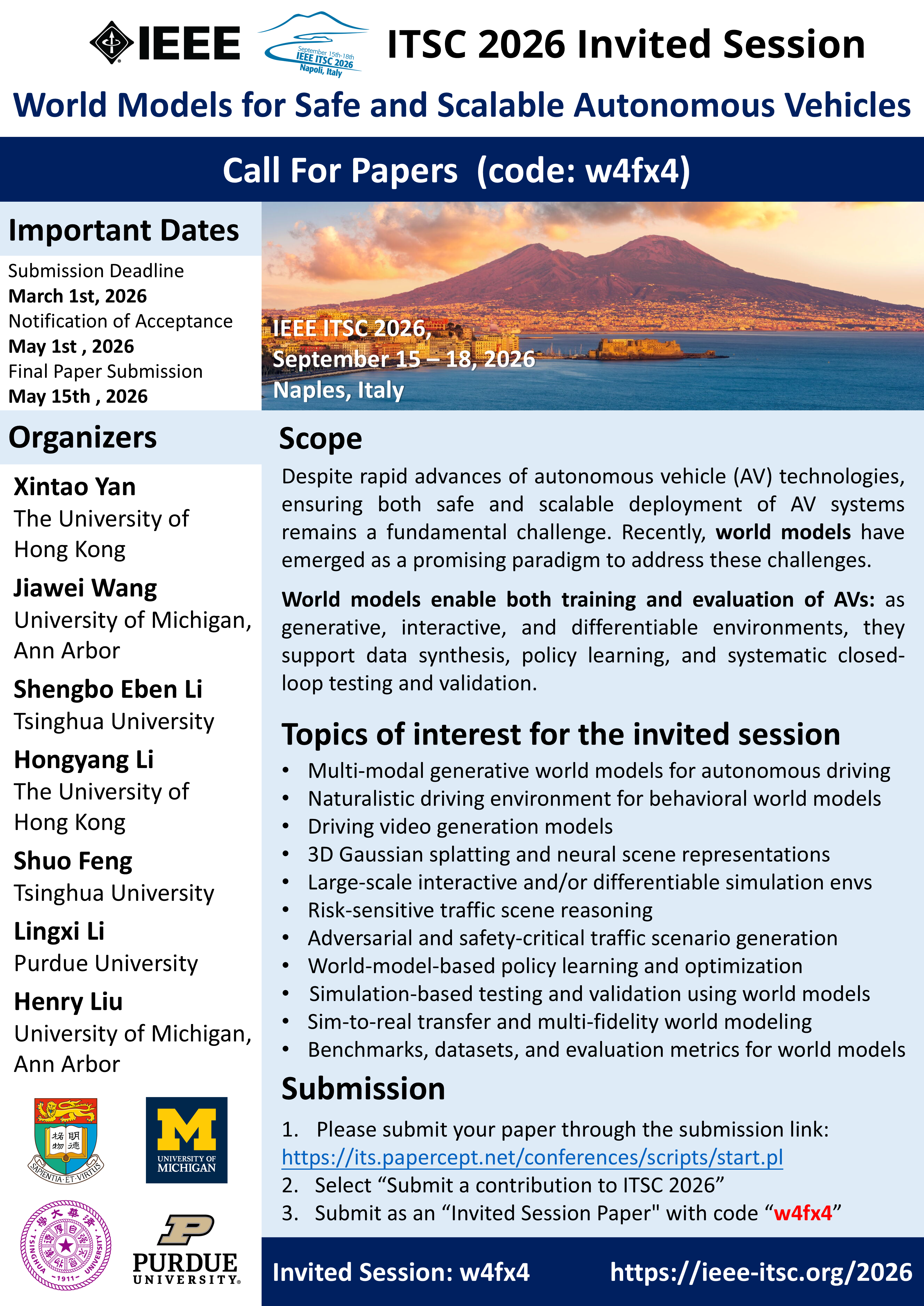
- 02/2026Invited session on world models for safe and scalable autonomous vehicles at ITSC 2026. Details available here.
- 12/2025We have been selected as semi-finalists in the USDOT ARPA-I Ideas and Innovation Challenge!
- 11/2025Our paper has been accepted by TR Part C.
- 11/2025Our paper has been accepted by IEEE TITS.
- 11/2025Our paper published in TR Part C has been recognized as ESI Highly Cited Paper!
Show older news
- 09/2025Check our new preprint on TeraSim-World. Codes and videos are available here.
- 08/2025Excited to begin my new role as a Lecturer in the CEE Department at University of Michigan!
- 07/2025Our paper about risk-adjustable driving environment by conditional diffusion was accepted by ITSC 2025.
- 05/2025Check our new preprint on generative behavior simulation for Autonomous Vehicles: TeraSim.
- 12/2024I was awarded Beijing 2024 Outstanding Doctoral Dissertation Award!
- 11/2024Our paper was accepted by IEEE T-ITS. Congratulations to my great collaborator Xu Shang!
- 11/2024Our paper was accepted by TR Part C. Congratulations to my great collaborator Shuai Li!
- 08/2024Check this demo for Green Wave Speed Advisory system in Mcity as part of the Smart Intersection Project.
- 06/2024We're excited to invite you to participate in the Mcity AV Challenge!
- 02/2024Check our new preprints on robust data-driven predictive control: Paper 1 and Paper 2.
- 01/2024Our paper was accepted to ACC 2024.
- 10/2023I was awarded the Distinguished Doctoral Dissertation Award from China SAE.
- 09/2023Excited to start my new position as Postdoctoral Research Fellow in the Michigan Traffic Lab!
Selected Publications
† equal contribution · * corresponding author · See Google Scholar for the full list.
Generative Simulation for Autonomous Driving
A simulation framework that generates statistically realistic and risk-adjustable traffic scenes using multi-agent conditional diffusion for stress testing of autonomous vehicle safety.
An open-source, high-fidelity traffic simulation platform designed to uncover unknown unsafe events and efficiently estimate AV statistical performance metrics.
Data-Driven Control and Digital-Twin Validation
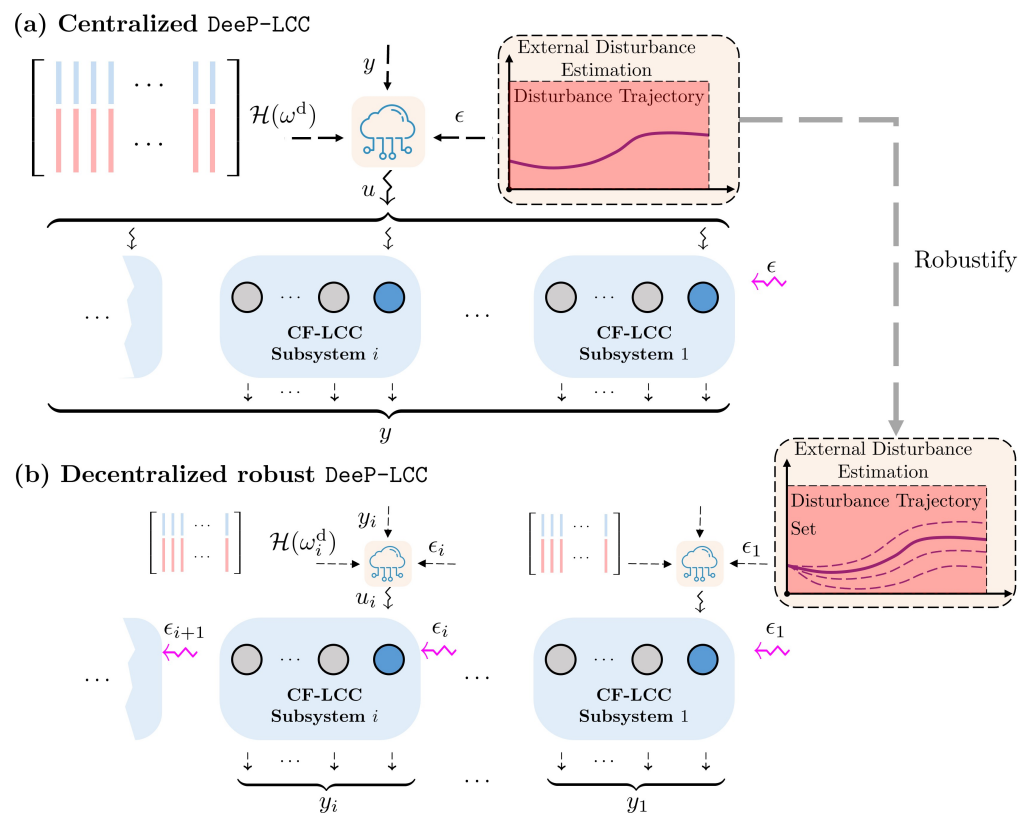
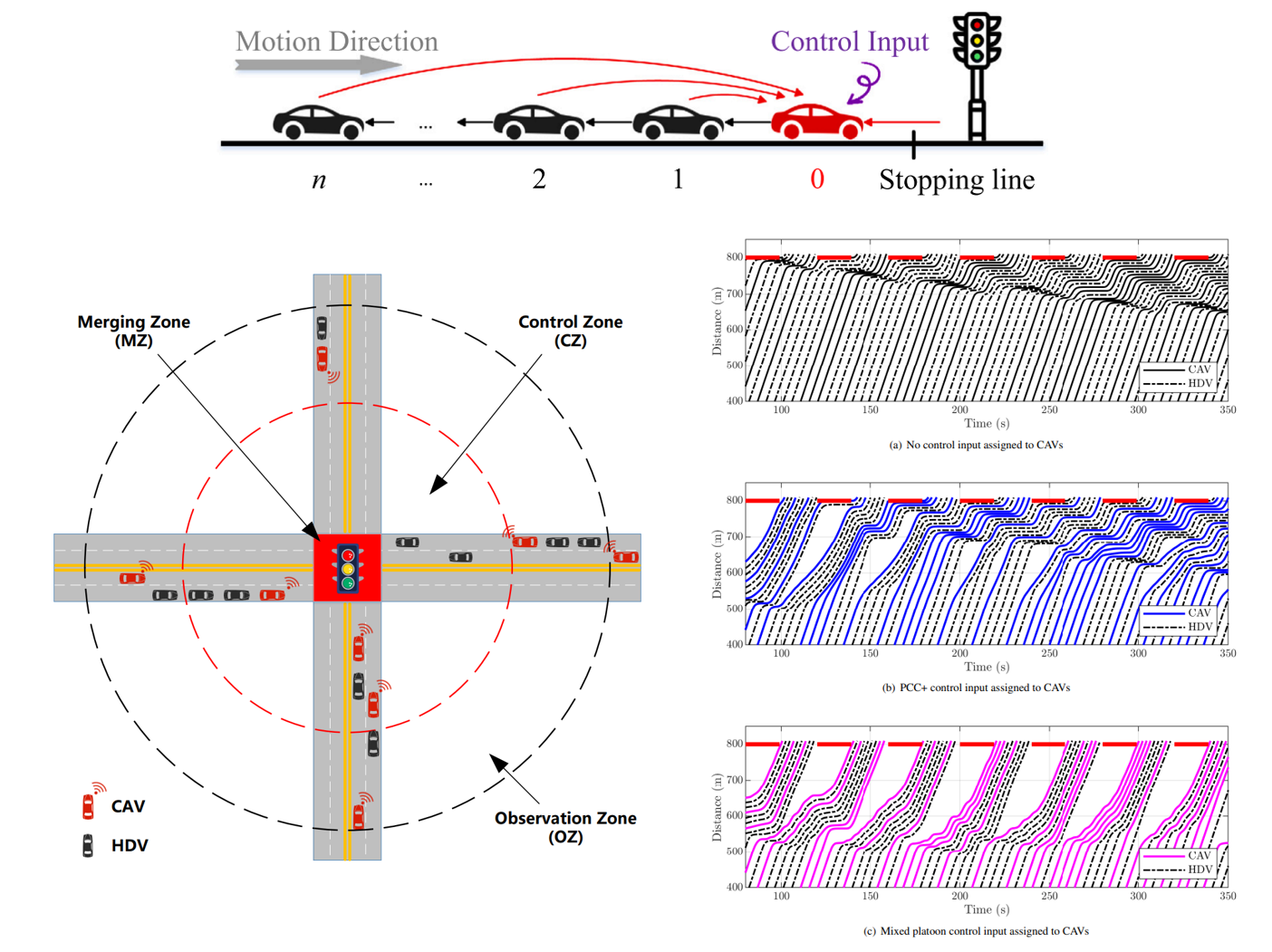
A decentralized robust data-driven predictive control framework for CAVs to smooth mixed traffic flow while ensuring computational scalability.
Robust data-driven predictive control framework for mixed platoons using reachability analysis to handle noise and attacks while ensuring safety.
First experimental validation of data-driven predictive control for CAVs in dissipating traffic waves using miniature experiment platform.
A cooperative distributed data-driven predictive control framework for CAVs in large-scale mixed traffic flow.
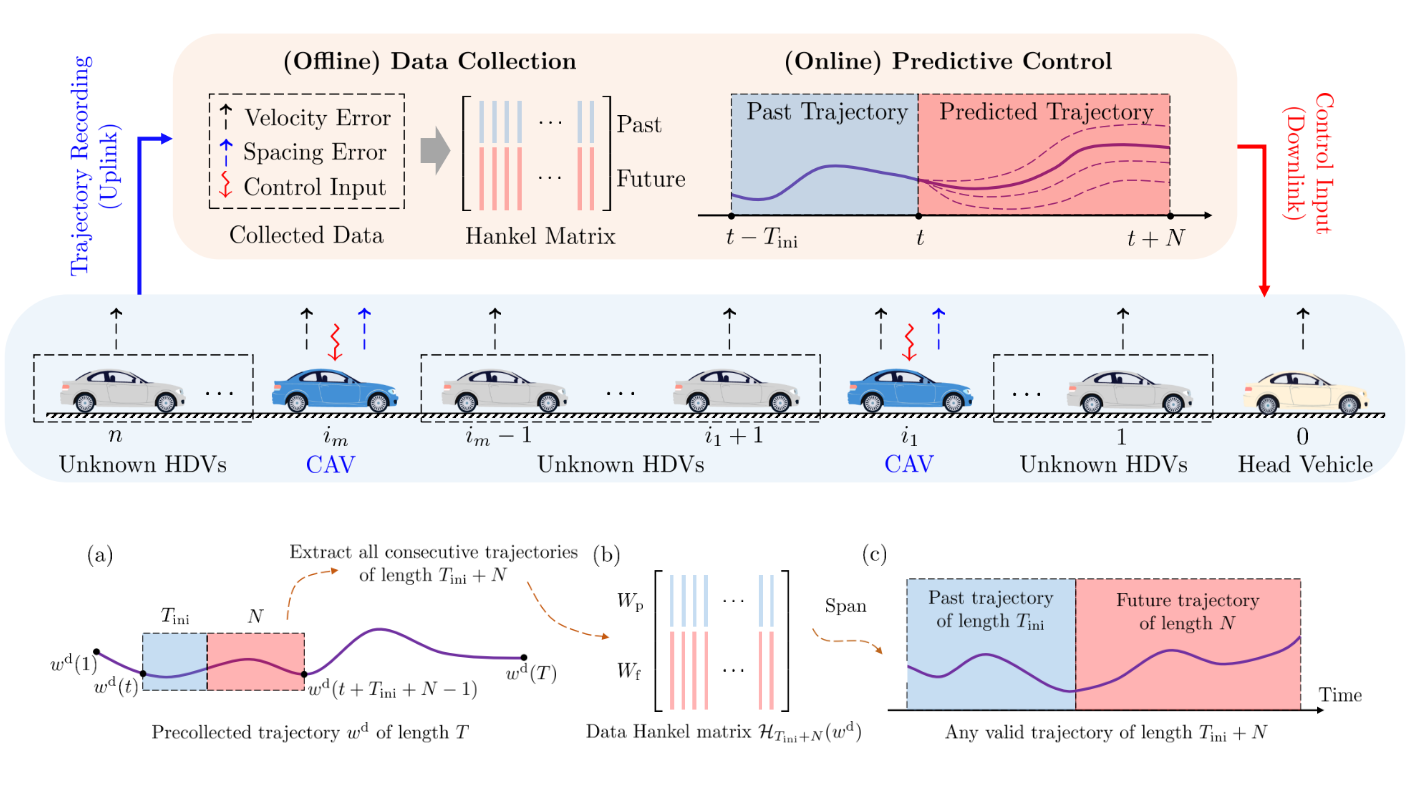
A data-driven nonparametric strategy for safe and optimal control of CAVs in mixed traffic using Willems' fundamental lemma and receding horizon optimization.
A miniature experimental platform MCCT based on Mixed Digital Twin concept for validating multi-vehicle cooperation and vehicle-road-cloud integration.
Principled Understanding of Mixed Traffic
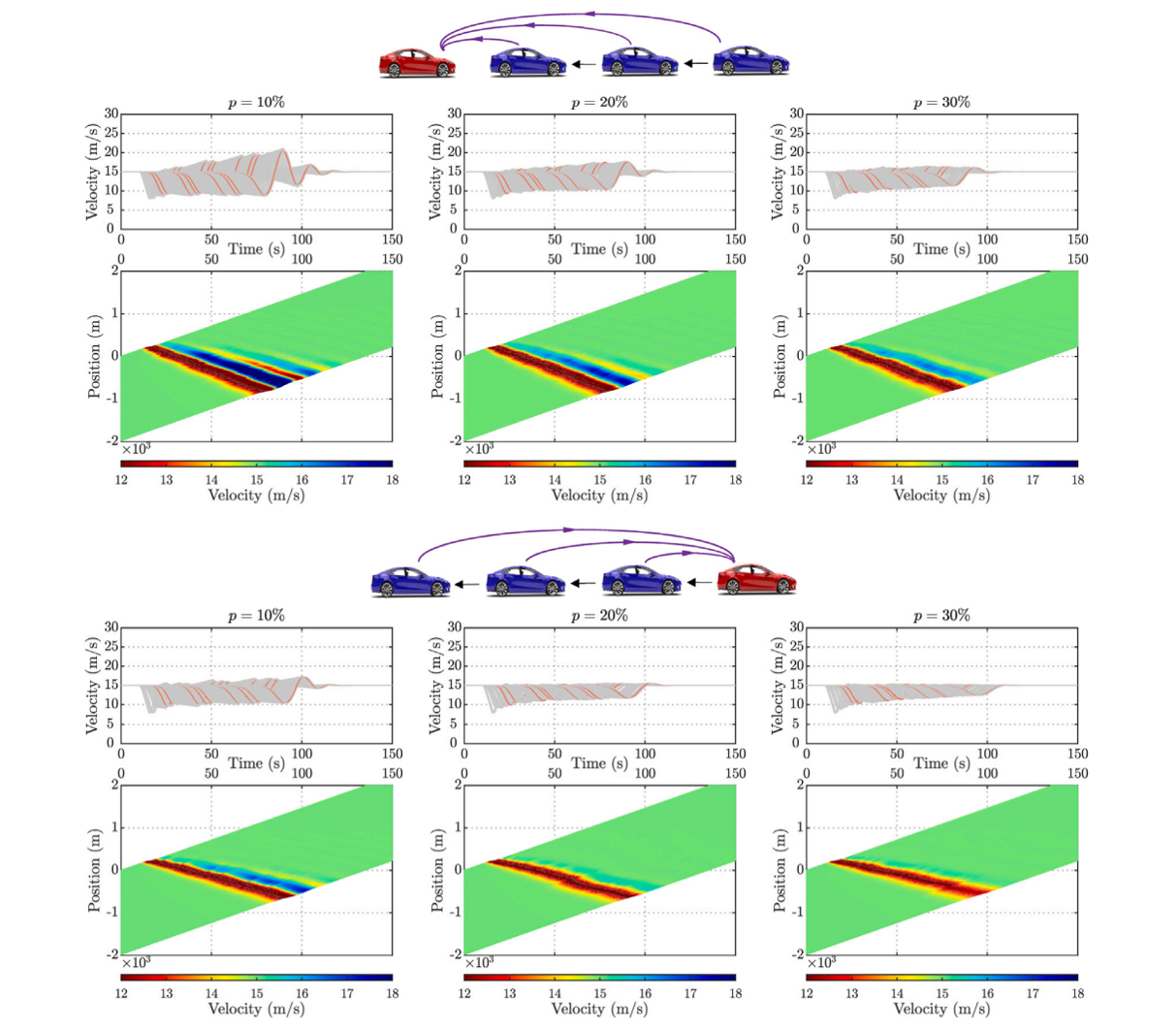
Investigation on how the information flow topology ("looking ahead" or "looking behind") and the maximum platoon size influence the stability of mixed traffic flow.
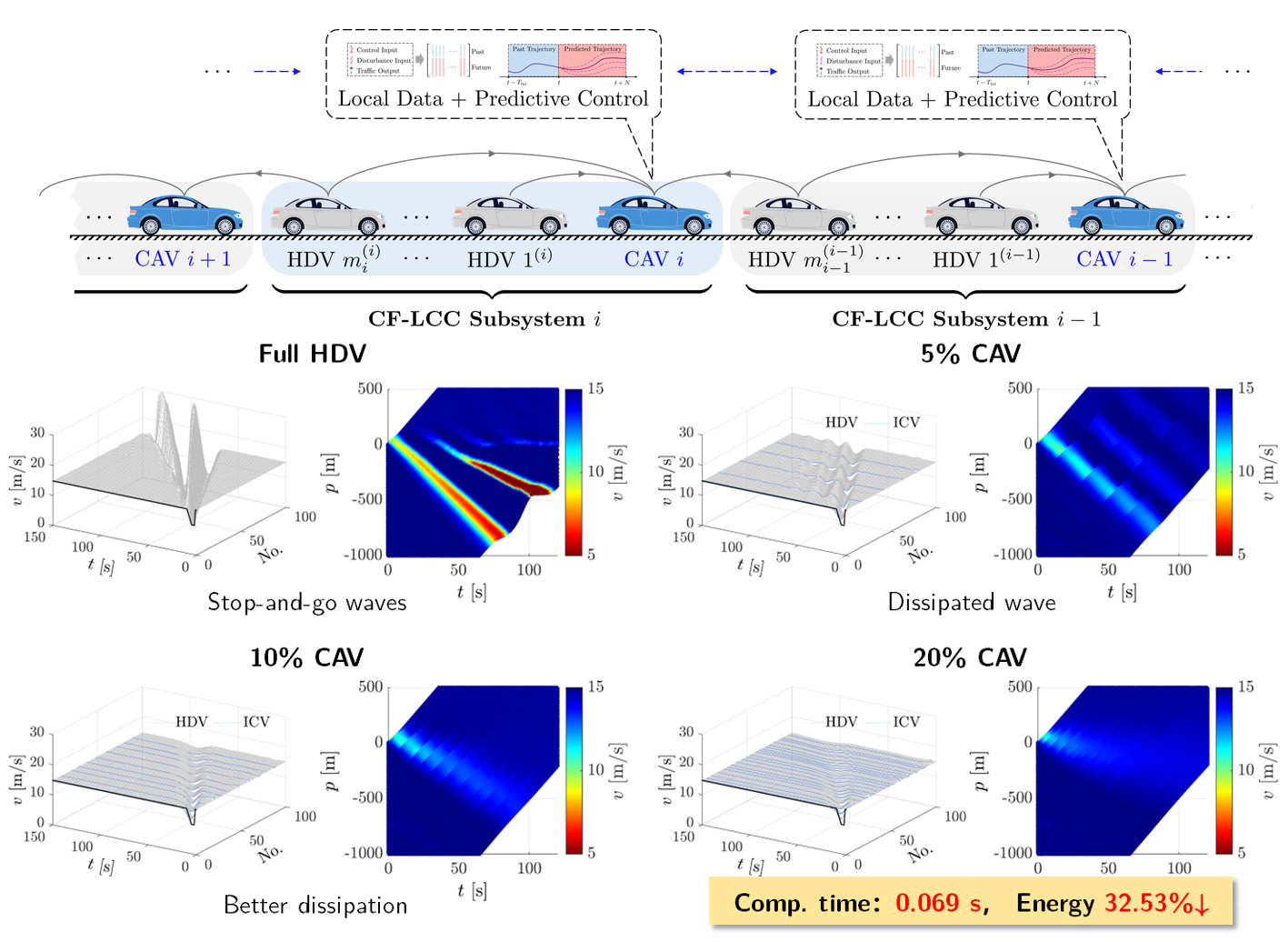
A novel Leading Cruise Control (LCC) framework for CAVs to actively lead the motion of the vehicles behind, while maintaining the car-following operations to the vehicles ahead.
Investigation of CAV formation patterns in mixed traffic from set-function optimization perspective, revealing optimal formations beyond platooning for system-level traffic benefits.
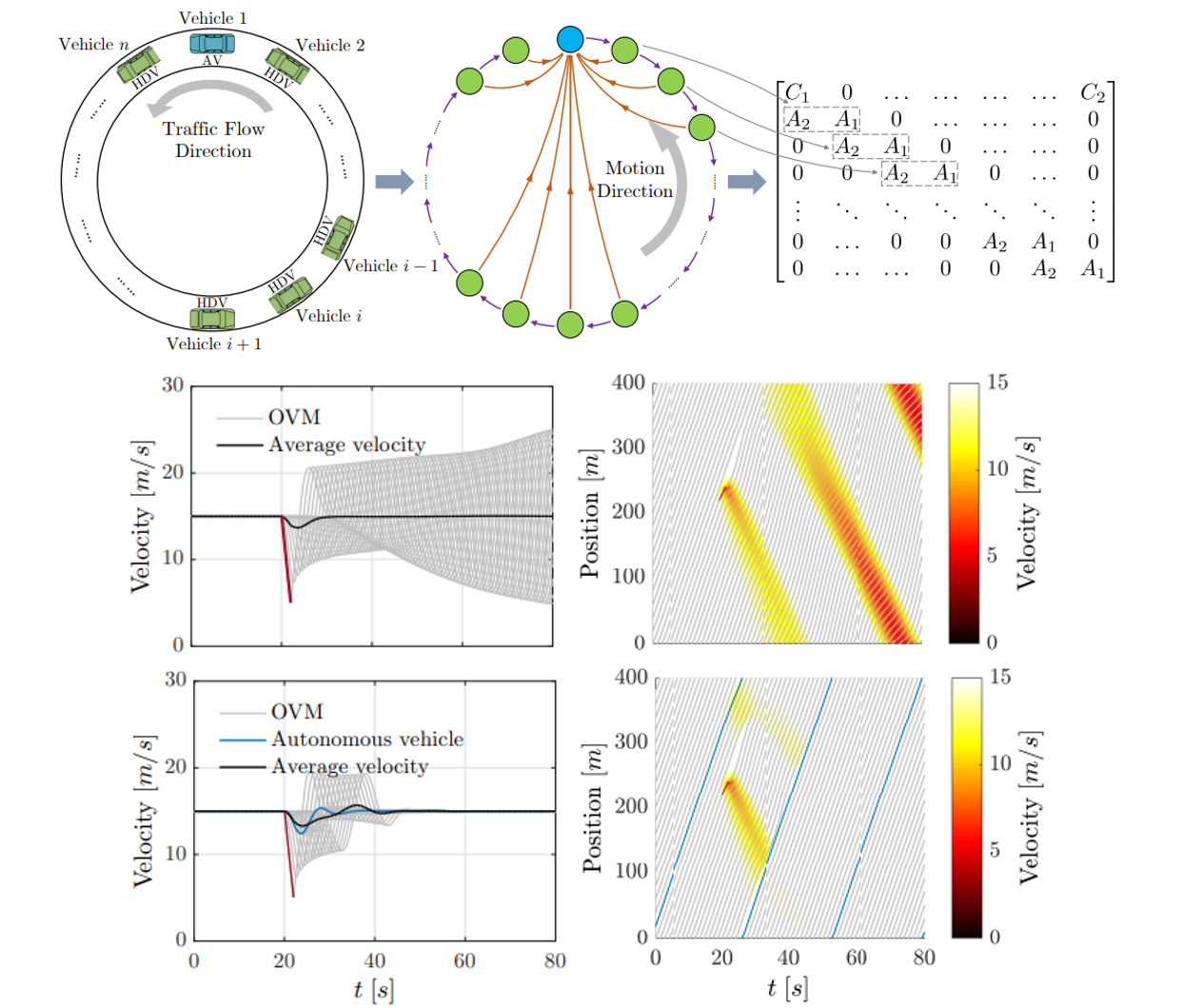
First rigorous proof of controllability and stabilizability properties of mixed traffic systems via CAVs with heterogeneous human-driven vehicles.
Proposes "1+n" control framework for CAV control at signalized intersections in mixed traffic, enabling the CAVs to significantly improve the traffic energy efficiency at a low penetration rate.
First rigorous theoretical analysis of controllability, stabilizability, and reachability of mixed traffic systems, showing that CAVs can effectively improve traffic with only 5% penetration rate.
Experience & Education

- Research Assistant Professor, University of Michigan Transportation Research Institute Oct 2026 – Present
- Lecturer, Department of Civil and Environmental Engineering Aug 2025 – Dec 2025
- Postdoc, Department of Civil and Environmental Engineering Sep 2023 – Sep 2026

- Visiting PhD, Automatic Control Laboratory Dec 2021 – Dec 2022

- Ph.D. in Mechanical Engineering Aug 2018 – July 2023
- Minor in Computer Application Aug 2015 – July 2018
- B.E. in Automotive Engineering Aug 2014 – July 2018
Teaching
- Instructor
-
- Fall 2025, CEE 551: Traffic Science, University of Michigan
- Teaching Assistant
-
- Fall 2020, Vehicle Control Engineering, Tsinghua University
- Spring 2020, Calculus, Tsinghua University
Service
- Associate Editor
-
- IEEE International Conference on Intelligent Transportation Systems (ITSC)
- IEEE Intelligent Vehicles Symposium (IV)
- Editorial Assistant
-
- Journal of Intelligent Transportation Systems, 2023–2025
- Organizer
-
- 2026, ITSC Invited Session on World Models for Safe and Scalable Autonomous Vehicles
- 2026, IV Tutorial on Generative AI Driven Simulation for Virtual Testing of Autonomous Vehicles
- 2026, CVPR Tutorial on Building GenAI based Simulation Environment for End-to-End Autonomous Driving
- 2024, Mcity AV Challenge
- Journal Reviewer
-
- IEEE Transactions on Intelligent Transportation Systems (TITS); IEEE Transactions on Automatic Control (TAC); IEEE Transactions on Control Systems Technology (TCST); IEEE Transactions on Transportation Electrification (TTE); IEEE Transactions on Intelligent Vehicles (TIV); IEEE Transactions on Control of Network Systems (TCNS); IEEE Transactions on Vehicular Technology (TVT); IEEE Transactions on Consumer Electronics (TCE); IEEE Internet of Things Journal; IEEE/CAA Journal of Automatica Sinica; Transportation Research Part C: Emerging Technologies; Transportation Science; Journal of Cleaner Production; European Journal of Control; Asian Journal of Control; Scientific Reports; Accident Analysis and Prevention; IET Intelligent Transport Systems; Automotive Innovation; Optimal Control, Applications and Methods; Journal of the Franklin Institute; International Journal of Systems Science; ACM Transactions on Cyber-Physical Systems; Chinese Journal of Mechanical Engineering; Sensors.
- Conference Reviewer
-
- CDC; IFAC; ACC; ICRA; IROS; ISTTT; TRB; L4DC; ITSC; IV; ICCPS; CICTP; ITSW; MECC.
Selected Awards & Scholarships
- 2026Winner, NVIDIA Academic Program Grant
- 2025Winner, U.S. Department of Transportation ARPA-I Ideas and Innovation Challenge Stage 1
- 2024Beijing Outstanding Doctoral Dissertation Award
- 2023Outstanding Doctoral Dissertation Award, China Society of Automotive Engineers
- 2023Outstanding Ph.D. Graduate, Tsinghua University
- 2023Outstanding Doctoral Dissertation Award, Tsinghua University
- 2022National Scholarship, Tsinghua University
- 2020National Scholarship, Tsinghua University
- 2018Best Paper Award in the 18th COTA International Conference for Transportation Professionals (CICTP)
- 2016Outstanding Student Leader Award, Tsinghua University
- 2015Outstanding Volunteer Scholarship, Tsinghua University
- 2015National Scholarship, Tsinghua University (Top 1 undergraduate in year 1)